Listen to this article
In this issue — 4 parts
Part 1 of 4
Four OpenClaw Flaws Chain Into a Full Server Takeover
The Problem: The Safe Room Around Your AI Agent Was Never Locked
Imagine you hire a brilliant new assistant and, to keep your business safe, you give them a small, locked office to work in. Inside that office they can read the documents you hand them, run calculations, and prepare drafts. The door is supposed to lock automatically. The assistant is not supposed to be able to wander into the executive filing room, read the company's bank passwords, or reprogram the building's security system. The locked office is the entire safety model. As long as the lock holds, you can let the assistant work quickly and trust that a mistake stays contained.
Now imagine that the lock had a flaw. If you jiggled the handle at exactly the right moment, the door would swing open. Once outside, the assistant could read every file in the building, copy the master keys, promote themselves to building manager, and quietly install a hidden door so they could come back in any time, even after you changed the locks. And imagine this assistant was not just yours. It was the same model used by hundreds of thousands of other companies, all running the same faulty lock, all reachable directly from the public internet.
That is precisely what security researchers at Cyera uncovered in OpenClaw, one of the most widely adopted AI agent platforms in the world. In May 2026, as reported by The Hacker News, Cyera disclosed four chained vulnerabilities, collectively nicknamed the "Claw Chain," that let an attacker start with a tiny foothold inside the agent's supposedly sealed sandbox and walk all the way out to full, system-level control of the host server. Along the way they could steal credentials, read files the agent was never meant to touch, impersonate the legitimate owner, and plant a persistent backdoor that survives reboots and patches.
OpenClaw is not an obscure tool. It became GitHub's most-starred project within three months of launch and is run by organizations across every industry to automate work across IT, revenue operations, HR, and security. Cyera's research, corroborated by reporting from BankInfoSecurity, found that somewhere between 65,000 and 180,000 OpenClaw instances were discoverable through internet scanning services like Shodan and ZoomEye, with roughly 245,000 servers reachable from the public internet. Every one of them, until patched, was running the same broken lock.
What Is an AI Agent Platform Like OpenClaw?
A traditional chatbot answers questions and then stops. An AI agent platform like OpenClaw goes much further: it lets an AI assistant actually do things on your computers and in your systems. You can tell it to pull a report from a database, run a script, update a configuration file, or call an external service, and it will carry out those steps on its own. To make this safe, OpenClaw runs the agent's activity inside a "sandbox," a deliberately walled-off environment where the agent is only allowed to touch a specific, limited set of files and resources. The sandbox is the seatbelt. It is the thing that is supposed to stop a runaway agent, or a manipulated one, from doing real damage to the underlying server.
The platform also has a "gateway," which is the control center that decides what the agent is allowed to do, schedules its tasks, and manages its execution environment. Think of the gateway as the building manager's office and the sandbox as the locked work room. The whole security promise rests on two assumptions: the work room stays locked, and only the rightful owner can sit in the manager's chair. The Claw Chain broke both assumptions at once.
This distinction matters enormously for executives. When you deploy OpenClaw, you are not just adding a clever writing tool. You are giving a piece of automated software a seat inside your infrastructure with real hands on real systems. The sandbox is the only thing standing between "the agent did its job" and "the agent, or whoever hijacked it, owns the server." When that wall fails, the blast radius is not a bad answer in a chat window. It is your credentials, your files, and your servers.
Why This Is Different From an Ordinary Software Bug
Most software vulnerabilities are single doors. A bug lets an attacker do one specific bad thing, and once you patch that door, the threat is gone. The Claw Chain is different and more dangerous because it is a chain. No single flaw on its own grants total control. Instead, four separate weaknesses link together like a series of stepping stones across a river. The attacker uses the first to get a slightly better position, then the second to reach further, then the third, then the fourth, until they are standing on the far bank with complete authority over the system. This is exactly how the most damaging real-world breaches unfold: not through one dramatic break-in, but through a patient sequence of small escalations.
Two of the four flaws exploit a subtle timing trick known as a "race condition," or more precisely a time-of-check/time-of-use (TOCTOU) flaw. The everyday version of this is a bank that checks your account balance, then waits a moment before actually completing the withdrawal. If you can sneak in during that gap and swap the account it is looking at, the bank approves one thing but does another. OpenClaw checked that a file operation was safe, then performed it a fraction of a second later, and in that gap an attacker could swap the target, redirecting the operation to a file outside the sandbox entirely.
The reason this matters so much to non-technical leaders is that the platform was doing exactly what it was told. There was no malware to detect, no obvious break-in to alert on. The agent ran its tasks, the gateway managed its schedule, and the server hummed along normally, all while an attacker quietly escalated from a sandboxed foothold to the keys to the kingdom. Traditional perimeter defenses, firewalls and antivirus, do not see this. The attack lives inside the trusted machinery of the agent platform itself.

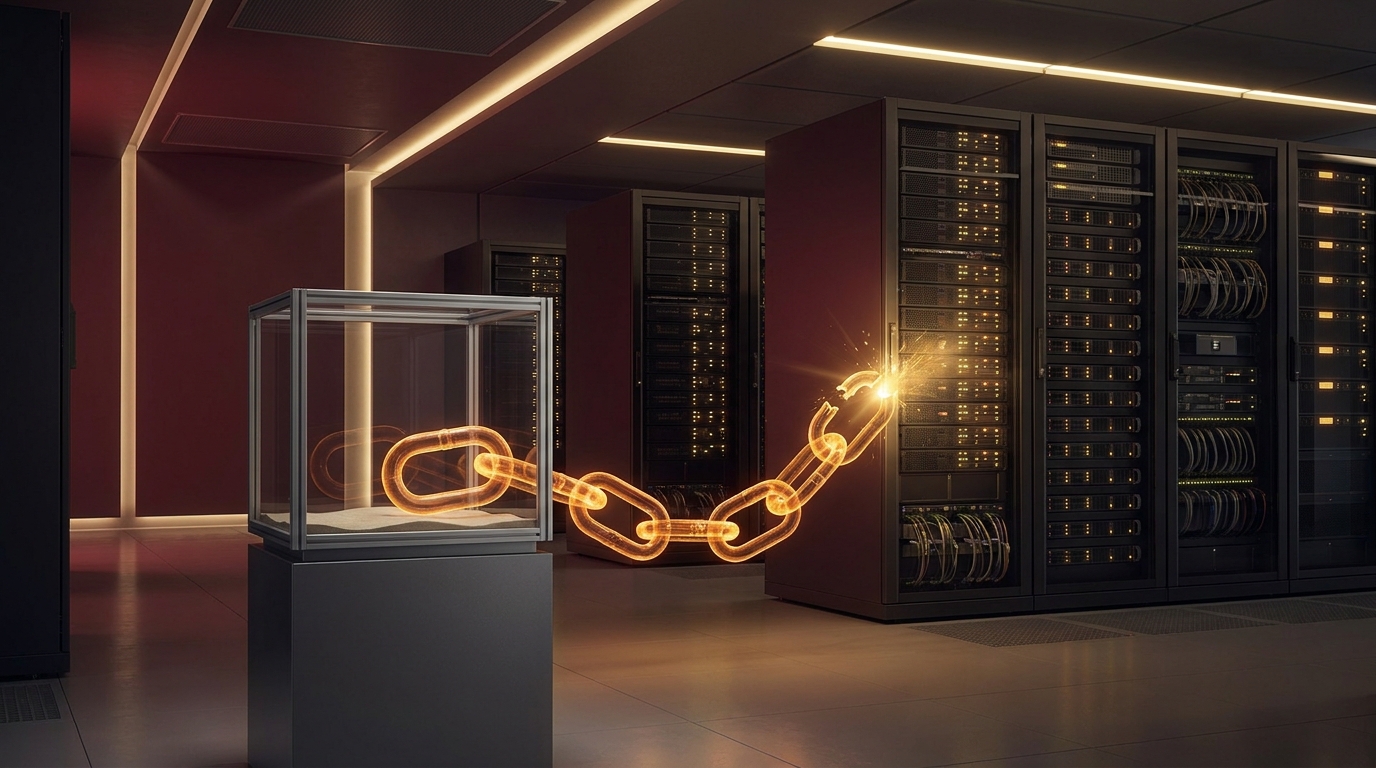
The Claw Chain lets an attacker walk from a small foothold inside the agent's sandbox all the way out to system-level control of the host, stealing credentials and planting backdoors along the way. Each link in the chain hands the attacker a slightly better position than the last.
Why This Matters to You
If your organization runs OpenClaw, or any self-hosted AI agent platform exposed to a network, the sandbox you are relying on to contain the agent may not contain it at all. The Claw Chain turns the agent's own execution environment into a launch pad for credential theft and server takeover. Because the agent was operating normally, the attack leaves little traditional forensic footprint, and a planted backdoor can persist long after you believe the incident is over.
The scale of exposure is documented, not hypothetical. Cyera found between 65,000 and 180,000 OpenClaw instances visible to internet scanners, with roughly 245,000 servers reachable from the public internet. The most severe flaw in the chain carries a CVSS score of 9.6 out of 10, near the top of the critical range. Any unpatched instance is a candidate for full compromise.
Coming up in Part 2 — the four flaws, and how they chain together to turn a contained AI agent into full control of the server.
Part 2 of 4
Four Flaws That Chain Into Total Takeover
What you missed: an AI agent platform's "safe room" was never actually locked — and that is a different, more dangerous class of bug than an ordinary vulnerability.
What Happened: Four Flaws That Chain Into Total Takeover
Cyera's researchers identified four distinct vulnerabilities in OpenClaw and demonstrated how they link together into a single, devastating attack path they named the "Claw Chain." Each flaw was assigned its own CVE identifier, the industry's standard catalog number for a vulnerability, and a CVSS score, a 0-to-10 rating of how severe it is. Below, each link in the chain is explained in plain terms, in the order an attacker would actually use them: first break out of the sandbox to read what you should not, then escalate to owner-level control, then plant a way back in for good.
What makes this research significant is that it was not a laboratory curiosity. Cyera, with researcher Vladimir Tokarev credited in the disclosure, reported the issues responsibly to OpenClaw, which patched all four in version 2026.4.22. The point of publishing the chain is not to arm attackers but to make clear that the sandbox model many organizations trusted was not the barrier they assumed. Here is what each flaw does.
CVE-2026-44115 — The Smuggled Command (CVSS 8.8)
The everyday analogy: Imagine a security guard who screens every package by checking the label, but never opens the box. As long as the label says "office supplies," it gets waved through, even if the box is full of tools for breaking out. OpenClaw inspected commands to make sure they looked safe, but its list of forbidden inputs was incomplete. An attacker could hide instructions inside special formatting that passed the label check but did something dangerous once unpacked.
Technically, this is an "incomplete list of disallowed inputs" vulnerability. OpenClaw's input filtering missed certain shell expansion tokens, special characters the operating system treats as instructions, when they appeared inside a particular kind of multi-line text block known as a "heredoc." A command could look perfectly benign during validation, then expand into something entirely different when it actually ran, exposing environment variables that often contain secrets such as API keys and passwords.
This is the attacker's opening move. By getting a crafted command through the filter, they gain the ability to execute their own instructions inside the sandbox and start harvesting the secrets stored in the environment. It is the foot in the door that makes every subsequent step possible.
Impact: Attacker-controlled commands execute inside the sandbox and environment variables, frequently holding credentials and API keys, are exposed. This establishes the initial foothold for the rest of the chain.
CVE-2026-44113 — Reading Through the Wall (CVSS 7.7)
The everyday analogy: Picture a librarian who checks that the book you requested is on the approved shelf, then turns to fetch it. If, in the half-second while their back is turned, you swap the shelf label, they hand you a restricted book instead. They followed the rules exactly; you simply changed the target during the gap between the check and the action.
This is a time-of-check/time-of-use (TOCTOU) race condition on the read side. OpenClaw verified that a file path was inside the permitted sandbox area, but there was a tiny window between that verification and the moment the file was actually opened. An attacker who could win that race could swap the path, causing OpenClaw to read a file outside the sandbox: system files and internal credentials the agent was never meant to reach.
With the foothold from the first flaw, the attacker now uses this one to break the confidentiality of the sandbox. They can read out the host's sensitive files and the credentials that live on it, gathering exactly the material needed to escalate their privileges in the next step.
Impact: The attacker reads files and credentials outside the sandbox boundary, exposing system secrets the agent was never supposed to access. Sandbox confidentiality is broken.
CVE-2026-44118 — Promoting Yourself to Owner (CVSS 7.8)
The everyday analogy: Imagine that anyone who could reach the manager's intercom from inside the building was automatically treated as the manager. The system assumed that if you were calling from a local line, you must be the rightful boss. An impostor who got into any internal phone could issue orders to the whole building and be obeyed without question.
This is an improper access control flaw. OpenClaw treated connections coming from the local machine (the "loopback" address that software uses to talk to itself) as inherently trusted. A non-owner process that could reach this local interface could impersonate the owner and seize control over the gateway, the control center that governs the agent's configuration, scheduling, and execution environment.
This is the privilege-escalation hinge of the chain. Having broken into the sandbox and read the host's secrets, the attacker now elevates from a confined intruder to the owner of the entire agent platform. They can now reconfigure what the agent does, schedule new tasks, and change the execution environment, with full authority.
Impact: The attacker elevates to owner-level control over the gateway, gaining authority over the agent's configuration, scheduling, and execution environment. This is the leap from intruder to administrator.
CVE-2026-44112 — Planting the Hidden Door (CVSS 9.6)
The everyday analogy: This is the same timing trick as the read-side flaw, but turned around to write instead of read. Picture a clerk who verifies they are about to file a document in the correct drawer, then, in the moment between checking and filing, has the drawer swapped beneath them. The document ends up in a drawer it should never have reached. Now imagine that document is a hidden key the intruder can use to let themselves back in forever.
This is the most severe flaw in the chain, with a CVSS score of 9.6 out of 10. It is a TOCTOU race condition on the write side: OpenClaw confirmed a write operation targeted a safe location inside the sandbox, but an attacker could win the timing gap and redirect that write to a destination outside the intended mount root, anywhere on the host the process could reach.
This is the persistence and game-over step. With owner control already secured, the attacker uses this flaw to write files wherever they want on the underlying server, planting a backdoor that grants ongoing, system-level access. Even if the original entry points are later noticed, the hidden door remains, which is what transforms a contained incident into a long-term compromise that can survive reboots and naive remediation.
Impact: The attacker writes files outside the sandbox to plant a persistent backdoor, achieving durable system-level control of the host. This is the step that turns a breach into a lasting compromise.
How It Works: The Gap Between What the Sandbox Checks and What Actually Happens
The heart of the Claw Chain is a deceptively simple idea: a security check and the action it authorizes are not the same instant. OpenClaw verified that an operation was safe, then a fraction of a second later carried it out. In that fraction of a second, an attacker could change what the operation actually touched. The system saw a safe request and approved it; the action that followed was anything but safe. This is the gap between what the sandbox checks and what really happens.
Think of airport security. The screener checks your boarding pass against your face at the checkpoint. But if there were a way to swap which passenger you are after the check but before you board, the screener's approval would be meaningless. They approved the person they saw; someone else walked through the gate. The TOCTOU flaws in OpenClaw are exactly this kind of identity swap, applied to files: the path is approved, then quietly substituted before it is used.
This is why the platform appeared to be functioning correctly the entire time. Every individual check passed. The logs would show legitimate-looking operations. There was no obvious alarm to trip, because from the system's own perspective nothing was wrong, the checks were being performed and were returning "safe." The danger lived entirely in the timing, an attribute that conventional monitoring is poorly equipped to see.
Same Operation, Two Different Realities
"Write the agent's output to /sandbox/workspace/result.txt — verified inside the allowed folder. Approved."
A safe, in-bounds file operation. The validation step confirms the target is inside the sandbox and gives the all-clear.
"Approved... but in the timing gap the path is swapped."
WRITE → /etc/host-startup/backdoor.sh (outside the sandbox, on the host)
The same approved operation, redirected to a location on the host outside the sandbox. A persistent backdoor is planted where it will run with system authority.
The sandbox checked a safe target and approved it; the attacker substituted a dangerous one in the gap before the action ran. This timing flaw is invisible to ordinary monitoring because every individual check legitimately returns "safe." Chained with credential theft and owner impersonation, it yields full server takeover.
Coming up in Part 3 — what a takeover like this actually costs, and why sandboxes keep getting treated as walls they were never built to be.
Part 3 of 4
What It Costs, and Why Sandboxes Keep Failing
What you missed: four CVEs that chain — smuggle a command in, read through the wall, promote yourself to owner, plant a hidden door — by exploiting the gap between what the sandbox checks and what actually runs.
By The Numbers
4
Chained Vulnerabilities
9.6
Highest CVSS Score (of 10)
~245k
Servers Reachable From Public Internet
2026.4.22
Patched Version
Cyera additionally found between 65,000 and 180,000 OpenClaw instances discoverable through internet scanning services such as Shodan and ZoomEye.
Financial Impact
Theft of credentials and API keys from the agent environment, owner-level hijacking of the gateway, and persistent backdoors that survive reboots and patching, requiring affected hosts to be rebuilt from clean images with full credential rotation.
Risk Severity Analysis
The four flaws carry different individual severities, but their true danger is cumulative: each one lowers the bar for the next. The following analysis maps each link in the chain to its CVSS severity and the business risk it represents when exploited as part of the full Claw Chain.
| Vulnerability | Severity | Business Risk |
|---|---|---|
| CVE-2026-44112 (write-side TOCTOU) | Critical (9.6) | Writes outside the sandbox plant a persistent backdoor and deliver durable system-level control of the host. This is the flaw that turns a breach into a lasting compromise that can survive patching. |
| CVE-2026-44115 (input filter bypass) | High (8.8) | Smuggled commands execute inside the sandbox and expose environment variables, frequently containing API keys and credentials. This is the initial foothold the rest of the chain builds on. |
| CVE-2026-44118 (owner impersonation) | High (7.8) | A local non-owner process seizes owner-level control of the gateway, taking over configuration, scheduling, and execution. This is the privilege-escalation hinge between intruder and administrator. |
| CVE-2026-44113 (read-side TOCTOU) | High (7.7) | Reads outside the sandbox expose system files and internal credentials the agent was never meant to reach, supplying the secrets needed to escalate privileges. |
CVSS scores as reported by The Hacker News from Cyera's disclosure. Several flaws were published with both a primary and a secondary score; the primary score is shown here.
Why This Keeps Happening: Sandboxes Treated as Magic Walls
Organizations adopted OpenClaw at extraordinary speed, fast enough to make it GitHub's most-starred project within three months, because it solved a real problem: it let AI agents actually do work across their systems. To make that safe, the platform offered a sandbox, and many teams treated the sandbox as a magic wall, an unbreakable boundary that meant they did not have to think hard about what permissions the agent really held or what the host could lose if the wall failed.
That assumption is the recurring root cause. A sandbox is not a magic wall; it is software, and software has gaps. Treating it as infallible led teams to expose OpenClaw directly to the internet, run it with broad access to the host, and store live credentials in the very environment the agent could reach. When the lock turned out to have a timing flaw, there was no second layer of defense behind it. The single barrier was the entire plan, and the plan failed all at once for hundreds of thousands of instances.
The deeper issue is that agent platforms blur the line between a tool and a privileged user. A traditional application does a fixed set of things. An agent platform is designed to be open-ended, to run whatever commands a task requires. That flexibility is the product. But it means the platform inherently sits in a position of enormous trust on the host, and any flaw in how it polices itself becomes a flaw in your entire infrastructure. The race condition was not exotic; TOCTOU bugs are a decades-old class. What was new was placing such a powerful, internet-reachable component on the host with the sandbox as its only meaningful guardrail.
The good news is that the remedy is mostly architectural rather than a product to buy. It means assuming the sandbox can fail and building so that a failure is contained: least-privilege access, network isolation, credentials kept out of the agent's reach, and the ability to detect and reverse what the agent has done. These are governance choices, and they are available to every organization today, regardless of which agent platform they run.
Coming up in Part 4 — six practical steps to close the gap, plus a governance checklist to score yourself against.
Part 4 of 4
Six Steps to Lock the Sandbox Down
What you missed: what a full takeover actually costs, and why sandboxes keep getting treated as walls they were never built to be.
What You Can Do: Six Practical Steps to Protect Your Organization
The Claw Chain is patched in OpenClaw version 2026.4.22, so the first step is immediate and obvious. But patching one chain in one product does not fix the underlying exposure, because the next flaw in the next agent platform is only a matter of time. The durable protection comes from treating your agent platform as an untrusted, privileged component and building defenses that hold even when its sandbox does not. Here are six practical steps any organization can take.

Effective defense assumes the sandbox can fail. Layer network isolation, least-privilege access, credential separation, and rollback so that breaking one wall does not hand an attacker the whole host.
Patch to 2026.4.22 immediately, and inventory every instance first
OpenClaw fixed all four Claw Chain flaws in version 2026.4.22. Upgrading is the single highest-value action available, and it should be treated as an emergency change, not a routine one, given the 9.6 CVSS rating on the most severe flaw. But patching only protects the instances you know about.
Before you patch, inventory every OpenClaw deployment across your environment, including the ones individual teams stood up without telling IT. Cyera found tens of thousands of instances exposed to the internet precisely because no central team was tracking them. Use the same internet-scanning perspective an attacker would, then confirm internally. You cannot patch what you do not know you are running.
Take the agent platform off the public internet
The roughly 245,000 publicly reachable servers turned a serious vulnerability into a mass-exploitation opportunity. There is almost never a good reason for an agent platform's control surface to be directly accessible from the open internet. Place it behind a VPN, a private network, or an authenticated gateway so that only trusted users and systems can reach it.
Network isolation is the cheapest, fastest form of defense-in-depth. Even if a future flaw bypasses the sandbox, an attacker first has to get to the platform at all. Reducing exposure from "anyone on earth" to "people already inside your network" shrinks the attack surface dramatically and buys you time to patch the next issue before it can be exploited at scale.
Keep credentials out of the agent's reach
Two of the four flaws led directly to credential exposure: one by leaking environment variables, the other by reading credential files outside the sandbox. The lesson is to assume the agent's environment will eventually be read by an attacker, and to make sure there is as little there to steal as possible. Do not store long-lived API keys, passwords, or master credentials in the environment variables or accessible files of the agent host.
Use short-lived, narrowly scoped credentials that expire quickly and grant only the specific access a given task needs. Pull secrets from a dedicated secrets manager at the moment of use rather than leaving them sitting in the environment. If a credential is stolen, a short-lived, narrowly scoped one limits the damage to a small window and a small blast radius, instead of handing the attacker the keys to everything.
Run the platform with the least privilege it can tolerate
The Claw Chain ends in system-level control because the platform was positioned to reach so much of the host. Limit what the agent process can do at the operating-system level: run it as a low-privilege user, not as an administrator; restrict which directories it can read and write; and isolate it from other workloads using containers or virtual machines so that a breakout from the agent does not become a breakout into the rest of your infrastructure.
The principle is to assume the sandbox will fail and design so that failure is survivable. If the agent can only touch a tightly bounded slice of the host, then even a full sandbox escape lands the attacker in a small, well-monitored box rather than on a server with reach into your crown jewels. Least privilege is the difference between a contained incident and an enterprise-wide breach.
Monitor for writes and reads that cross the sandbox boundary
Because the TOCTOU flaws redirected operations outside the intended mount root, a telltale sign of exploitation is the agent process touching files it should never touch: writing into system startup directories, reading credential stores, or modifying gateway configuration outside the normal workflow. Set up file-integrity and access monitoring on the host so that any operation reaching outside the agent's designated area raises an immediate alert.
Pay special attention to anything that looks like persistence: new files in startup or scheduled-task locations, changes to the gateway's owner or configuration, and unexpected new scheduled jobs. These are the fingerprints of the backdoor step. Catching them early is the difference between evicting an intruder and discovering, weeks later, that they never actually left.
Plan to rebuild, not just patch, after a suspected compromise
The most insidious part of the Claw Chain is the persistent backdoor. Once an attacker has planted a hidden door outside the sandbox, simply updating to the patched version does not evict them, because the backdoor lives in the host, not in the vulnerable code. If you have reason to believe an instance was exposed and exploited, you must assume the host itself is compromised and rebuild it from a known-good image rather than trusting a patch alone.
Maintain the ability to do this quickly: infrastructure-as-code so hosts can be recreated from scratch, recent clean backups, and rotation of every credential that lived on the affected host. The organizations that recover well from this class of incident are the ones that can confidently throw away a potentially poisoned server and stand up a clean one in minutes, rather than agonizing over whether they have truly cleaned a machine they can no longer trust.
Governance Checklist
Does your AI agent platform deployment include these critical controls?
Most organizations currently lack the controls marked with ✗. Implementing even two or three of these controls significantly reduces exposure to agent-platform takeover.
AuthorityGate Governance Framework
AuthorityGate's 8-gate model addresses self-hosted agent platform risk directly. Gate 1 (Pre-Validation) flags internet-exposed and over-privileged agent deployments before they go live. Gate 4 (Security Scan) tracks CVE exposure and detects boundary-crossing file operations that signal sandbox escape. Gate 6 (Operational Resilience) ensures the platform is isolated and least-privileged so a sandbox failure stays contained. Gate 7 (SME Approval) gates high-impact configuration and credential decisions through independent review. Gate 8 (Recovery Plan) mandates the rebuild-from-clean-image and credential-rotation capability needed to evict a persistent backdoor.
The framework treats AI agent platforms as untrusted, privileged components by default, applying the same governance rigor to them that organizations already apply to third-party vendor access and internet-facing infrastructure.
The Bottom Line
The OpenClaw Claw Chain is a clear warning about the way organizations are deploying AI agent platforms. The sandbox that was supposed to contain the agent was the entire safety model, and when four chained flaws broke it, the result was credential theft, owner impersonation, and a persistent backdoor delivering full server takeover. This was not an exotic attack; it chained a decades-old class of timing bug with an incomplete input filter and a trust-the-local-connection mistake. The patch in version 2026.4.22 closes this particular chain, but the underlying lesson is structural.
The organizations that fared best were not the ones with the cleverest detection; they were the ones who never treated the sandbox as a magic wall. They kept the platform off the public internet, ran it with least privilege, kept live credentials out of its reach, and could rebuild a compromised host from a clean image in minutes. Defense-in-depth is what turns a critical vulnerability in someone else's code into a manageable incident rather than an enterprise breach.
With Cyera documenting tens of thousands of exposed instances and roughly 245,000 reachable servers, the only safe assumption is that an unpatched, internet-facing OpenClaw instance is a candidate for compromise. Patch now, verify you have found every instance, and build the layered defenses that hold even when the next sandbox fails, because there will be a next time.
This article is part of our incident analysis newsletter series. Subscribe to receive complete analyses with risk matrices, governance checklists, and actionable recommendations.